School
School of Porto: a principle of disquiet
Pedro Levi Bismarck
Reading Time10’
To co-commemorate implies a mode of remembrance that is collective and co-elective. It means summoning a foundational essence that belongs to all. In fact, the reason Fernando Távora can be co-commemorated on his centenary is insofar as he embodies the founding condition of a common ground that defines a particular way of seeing, understanding, and practicing architecture often referred to as the School of Porto.
Throughout my studies at the Faculty of Architecture, I always experienced a certain ambivalence, or even unease, concerning this designation. I understand why now. In fact, with few exceptions, no one truly knew what it entailed: “It is the Drawing!”, “It is the Project!”, “It is History!”, “It is the synthesis of everything!”.
In this sense, the expression “School of Porto” truly possessed the power of a myth: it belonged to that realm of things one can only know on the condition of not knowing what they are. To paraphrase Gertrude Stein, one could effectively say that the “Porto School is the Porto School is the Porto School is the Porto School”. Yet, if the school became a myth—if it was mythologized — it is precisely because, at a certain point, it had to mystify its own conditions of existence. This occurred amidst a rapid transformation of the profession and of universities from the late 1990s until the final blow dealt by the 2009–2015 crisis. The financial and economic crisis did more than just challenge a model of construction and architectural practice that had flourished in Portugal since the 1980s; it called into question the very material conditions —political, social, and economic — that sustained it: in other words, the end of the Welfare State project and the definitive rise of a neoliberal market order.
At the same time, the slow and painful dilapidation of the very idea of the university — where the “transmission of knowledge” gave way to the “acquisition of skills” — further exacerbated a purely technical turn in architectural education. With a student profile increasingly driven by the logic of the portfolio and entrepreneurship, yet haunted by the prospect of professional proletarianization and precariousness, we witness a positivist becoming of the project. It is a path increasingly focused on the “how-to” rather than asking “why do we do it?”, even if it seeks occasional solace in the horizon of the “professione poetica”.
Curiously, those who seemed most concerned about this state of affairs were, with few exceptions, no longer within the school, but outside it. Sérgio Fernandez, Alexandre Alves Costa, Álvaro Siza, and even Eduardo Souto de Moura appeared to be the only ones voicing public concern regarding this process of transformation. At the school, however, the myth had become the form — or rather, a formula for silence.
It was precisely in conversation with Eduardo Souto de Moura in 2023, during an interview for Electra magazine, that I was finally able to recognize the common constituent element uniting all these generations of architects — Távora, Siza, Souto de Moura — and which seemed to define the core of this entity known as the School of Porto. If it were possible to reduce this element to a single word, I would venture to say: disquiet. Perhaps it could even serve as the title for a monograph: School of Porto: A Principle of Disquiet. It is not the drawing, nor the project, nor history that defines this school, but a sense of questioning the things of the world through the lens of architecture; a restlessness marked by the tension between the ethical and social mission of architecture and the (un)postponed possibility of its realization as a project by all for all — the city, locus architectonicus. It is, furthermore, a disquiet found in the relationship between the discipline and the profession, in the tension between the local conditions of practice and the universal language of architectural knowledge.
For Fernando Távora, as for Álvaro Siza or Souto de Moura, architecture is not simply a mode of practice, but a form of knowledge. In his interview, Eduardo Souto de Moura encapsulates this principle in the phrase: “there is no design without culture”. The same warning regarding schools and teaching was already present in Távora’s words in 1971, when he stated, as candidly as he did lapidarily, that “the idea that an architect must, above all, be a wonderful pencil is an outdated one; because there are no wonderful pencils without wonderful little heads”.
If Álvaro Siza and Eduardo Souto de Moura are the only prominent architects in Portugal to have used their visibility to voice doubts about the current state of architecture, it is because they hold fast to an idea of “architecture-as-project” that is now definitively under threat. But it is also because they maintain the condition of the homme de lettres — as Le Corbusier used to call himself — which defines them not merely as architects, but as intellectuals. Ah, intellectuals — what an unfashionable word! And yet, it was precisely this figure of the architect-as-intellectual that shaped and constructed the disciplinary heritage of the 20th century. This is the condition that both Siza and Souto de Moura embody, each in their own way: a vocation for permanent questioning and self-reflection — not in what makes them singular, but in what makes them plural. Not just introspection, but extrospection.
A vocation for disquiet in the world, we might say — one that both undoubtedly owe to Fernando Távora; a principle of disquiet that has animated an entire way of being architecture, yet one that is increasingly estranged from the current state of the School of Porto. The school’s problem is not — as we so often hear — that it is standing still in time, but that it has lost its critical relationship with time: with the past, the present, and the future. It is somewhat like Kafka’s The Castle: the messengers keep going back and forth with their messages, but no one truly knows what they mean or for whom they are intended. Tradition, heritage—as Jacques Derrida once wrote—is not a given, but a task.
That’s why the challenge posed by co-commemoration is as fundamental as it is decisive. The risk inherent in any commemoration is always that of going to meet the past, when the task is precisely the opposite: to bring the past to meet the present, to challenge our current condition and our continuous immersion in the passivity of the “time-of-now”. In short: to make the past our faithful contemporary.
Co-commemorating Fernando Távora must, therefore, inevitably serve to recognize his work, his biography, and his historical legacy; but it must also serve to recognize the present: to confront a way of being an architect — a model Távora never tired of encouraging and mobilizing — that today seems to be definitively on the path to extinction. It means confronting a model of the profession and a social and political sense of the discipline that is currently in crisis; to confront a model of university teaching and of architectural learning that is in deep agony. Furthermore, it means — last but not least — confronting the now dominant model of disqualifying and devaluing intellectual work, research, and study — pursuits to which Távora dedicated himself so passionately throughout his life. This is an unavoidable responsibility that falls, first and foremost, upon institutions like the one where we stand today. Yet, without providing the minimum material conditions necessary for those who dedicate themselves to such work, the very forms of co-commemoration are definitively jeopardized.
What is the point of accumulating the past if it has become a mere souvenir, if we are incapable of knowing it? What is the point of building vast archives if the conditions for research are scarce and it is treated as a kind of willful hobby? We must not forget — as Walter Benjamin did in the midst of the expansion of Nazism and Fascism in the early 1940s — that history is not a dead archive, but an unrelenting battle:
"In every era, the attempt must be made anew to wrest tradition away from a conformism that is about to overpower it [...] Only that historian will have the gift of fanning the spark of hope in the past who is firmly convinced that even the dead will not be safe from the enemy if he wins. And this enemy has not ceased to be victorious".— Walter Benjamin
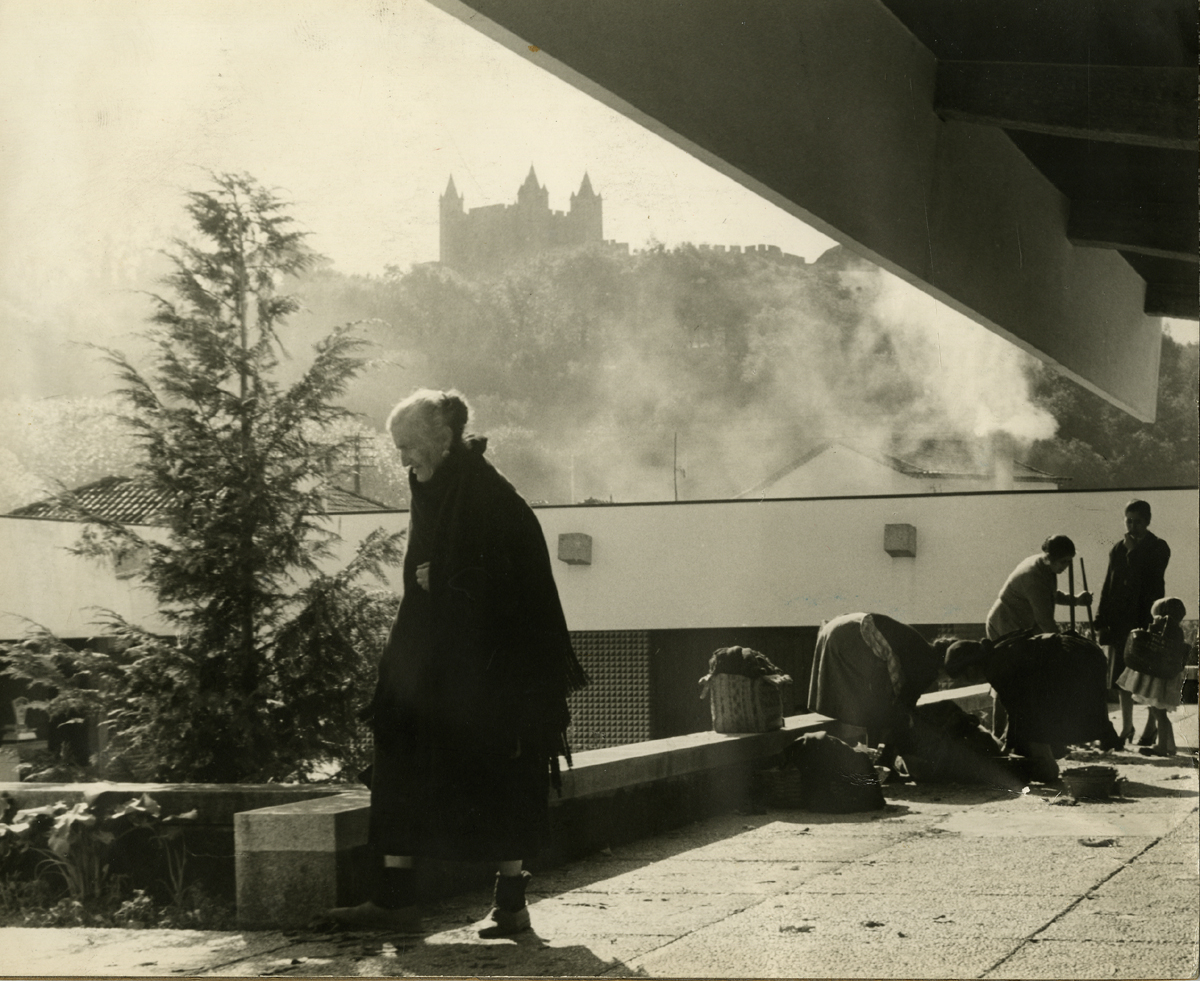
- Editor’s note: this text corresponds to the epilogue of a presentation given at the Marques da Silva Foundation (January 2024) about the Távora’s Vila da Feira Market, entitled “The solitude of architecture”. This session took place as part of the program commemorating the centenary of Fernando Távora’s birth and the exhibition “Fernando Távora. Free thought”, curated by Alexandre Alves Costa.